St Mary and All Saints Church, Whalley Parish Church, Roman Altar and Misericords
|
|
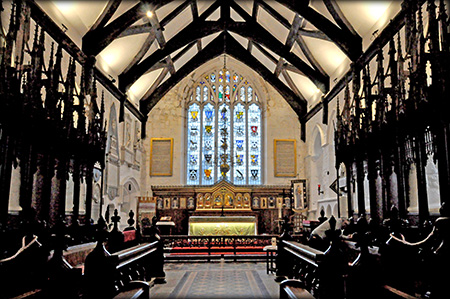
Chancel with 15th century roof |
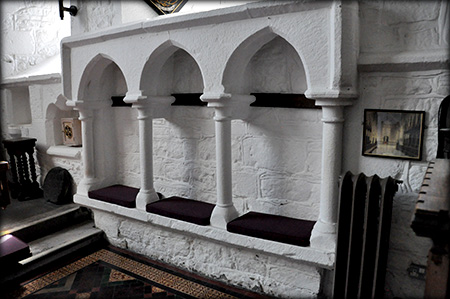
13th century sedelia |
13th century bronze door knocker |
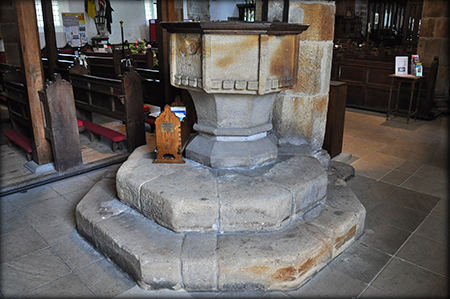
15th century Font |
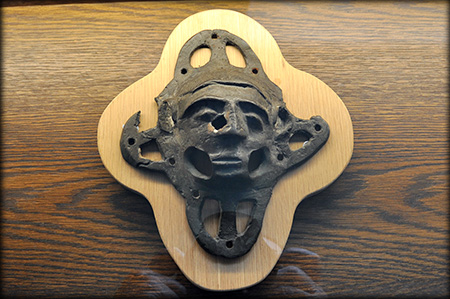
Roman altar, believed to be a depiction of Mars |
1670? |
|
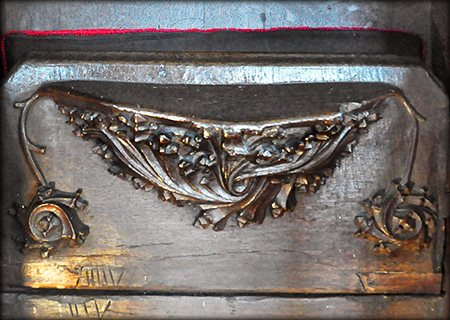
The misericords at Whalley are said to be one of the most interesting sets in the country, they certainly captured the attention of myself and José, we were totally enthralled. It is believed they were acquired by St Mary's from Whalley Abbey sometime after the dissolution of the monastery in 1536. Eighteen of the 15th century misericords are present at St Mary's, a further eight are situated in the north transept of Blackburn Cathedral. The modern misericords at St Mary's may have been added when the choir stalls were restored in 1866. |
|
North 01. Flowers (Modern) Supporters: Leaves and Pine cones |
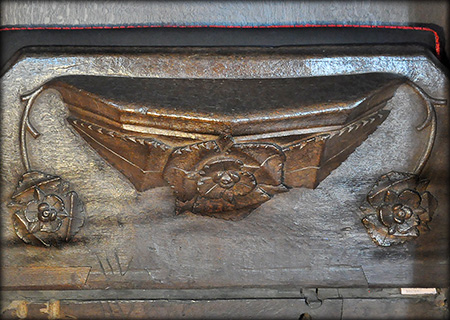
North 02. Flowers (Modern) Supporters: Leaf |
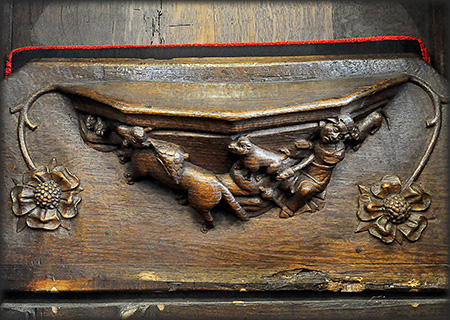
| Below left is one of the modern misericords. In the scene below right we see a cunning fox with a goose in it's mouth heading toward its den. Meanwhile a woman, with her distaff and spindle in hand, has fallen asleep on the job, while her dog is idly watching. | |
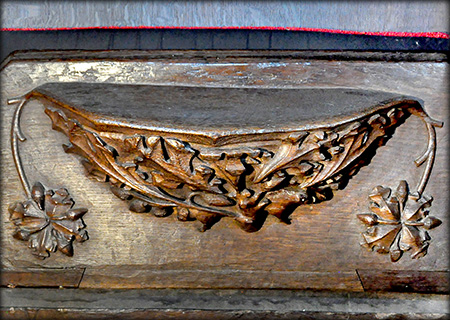
North 03. Flowers (Modern) Supporters: Leaves and Acorns |
North 04 Sleeping woman, a dog and a fox Supporters: Rose |
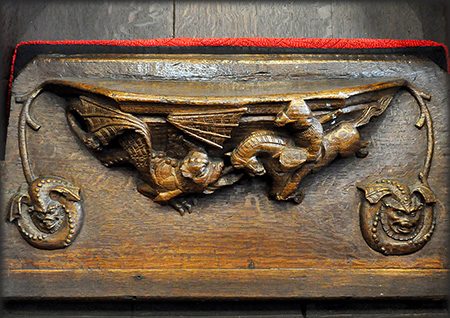
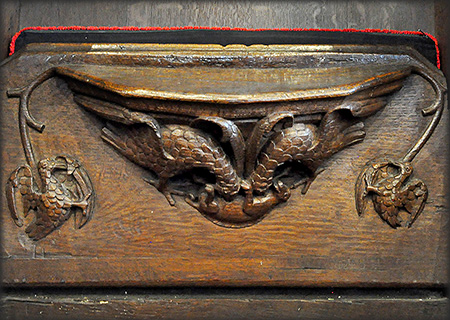
| Below left is an excellent carving of St George and the dragon symbolising Valour, Honour and the triumph of good over evil. On the right two eagles are depicted preying on a lamb. During the medieval period this was viewed as a metaphor for incarnation and atonement. | |
North 05. George and the Dragon Supporters: Dragon |
North 06. Two Eagles tearing intestines of a Lamb Supporters: Eagle |
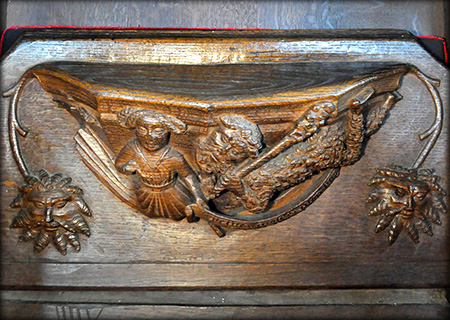
| Below right we see a depiction of an elegant woman wearing a flowing dress with a Satyr or Woodwose, AKA the wildman of the woods, lustfully watching her with a club in his hand. The woman is carrying a banner with the following inscription 'think much and speak little' | |
North 07. Satyr and Woman Supporters: Heads |
North 08. Foliage Curly leaf Supporters: Whorled leaves |
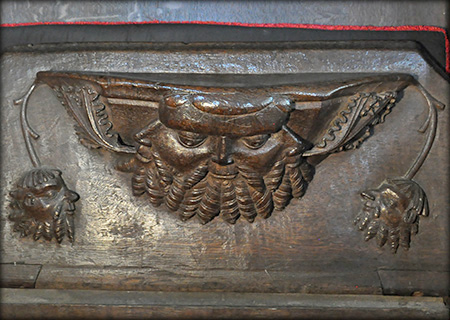
| Below left is another foliage carving, which I still have not identified. Below right is a man with three faces, it was an image that appeared frequently in medieval art up until the 17th century, when it was banned by the catholic church. It represented Trinitarian unity or three persons in one God. | |
N 09. Broad leaf foliage Supporters: Floral leaf |
North 10. Three faced head Supporters: Heads with beard |
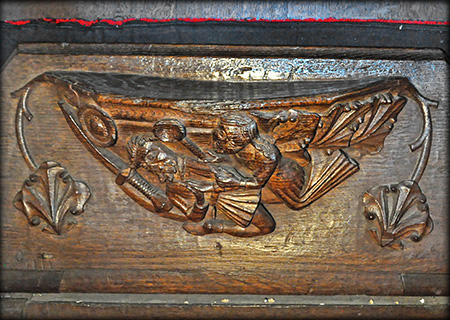
| Below left is a carving of oak leaves with a small mouse. On the right we have a warrior, with his sword lying behind him. His wife is appears to be hitting him with a frying pan or ladle, while he prays to his God for mercy. He is certainly being humbled. | |
N 11. Oak leaves and Mouse Supporters: Leaf with Acorns |
North 12. Warrior and Wife Supporters: Fleur-de-lys/Lily |
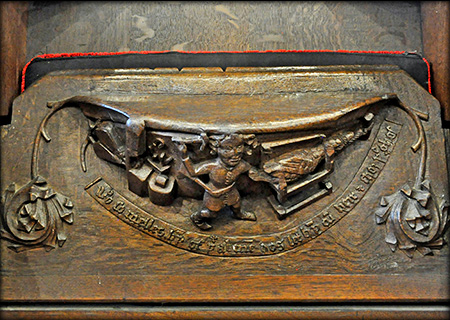
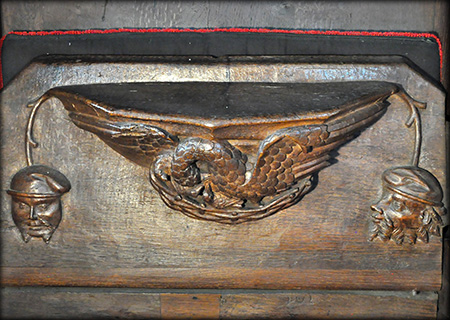
| The misericord below left features a griffin carrying a swaddled infant. Griffins were a symbol of strength, protection and vigilance against evil. Below left shows a blacksmith holding his hammer in his right hand, he is trying to shoe a goose lying on his anvil. Underneath them is an inscription telling us not to waste our time interfering in other people's business or on foolish endeavours. | |
South 01. Griffin with Swaddled infant Supporters: Whorled leaf |
South 02. Shoeing the Goose Supporters: Whorled leaf |
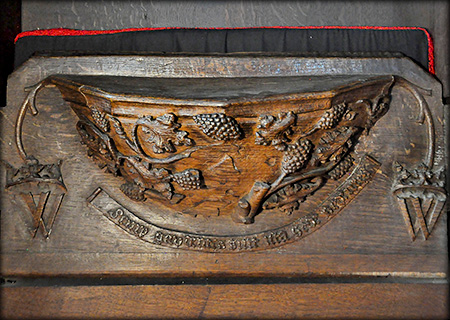
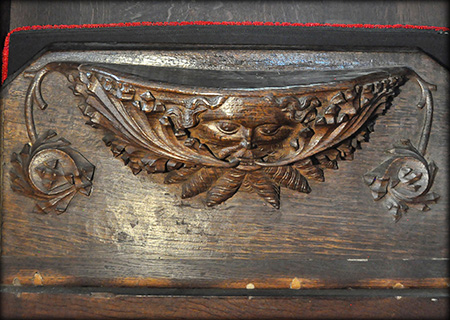
| Below left is the Abbots misericord with the latin inscription: Semp(er) Gaudentes sint ista sede sedentes meaning 'Joyful be they who sit here.’ The supporters bear the initials of William Whalley who was the Abbot from 1418-1434. Below right is a carving of the green man, a symbol of rebirth and a reminder of mortality, often found in medieval churches. | |
South 03. Vine wreaths and Grapes, Inscription Supporters: Initials |
South 04. Green man Supporters: Whorled leaf |
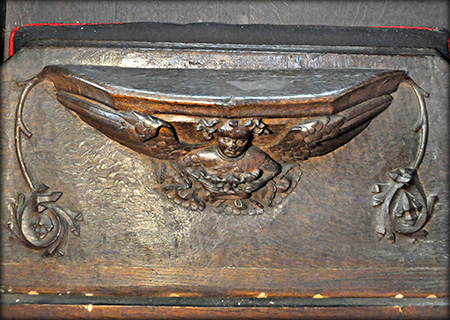
| The misericord below left bears a carving of an angel holding a bunch of flowers. Below right is a depiction of Alexander the Great's flight to the heavens. He is sitting in a sling tied to two griffins, holding two sticks with meat on the ends, as he holds the meat up high the griffins take flight in order to reach the meat, thus bringing Alexander up into the sky. | |
South 05. Angel Supporters: Leaves |
South 06. Alexander the Great with two Griffins Supporters: Floral design |
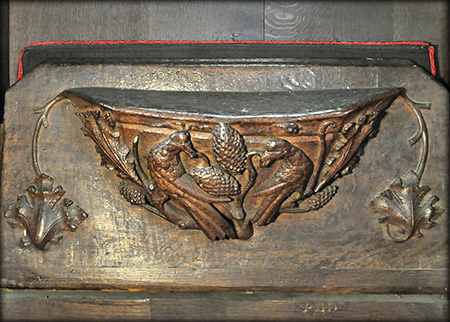
| Below left: Shows a pelican piercing its breast with her beak in order to revive her young with her own blood. The pelican represents Christ. On the right we have two birds with pomegrantes. Pomegranates were a symbol of fertility, abundance, resilience and eternal life and were believed to contain all of God's commandments. | |
South 07. Pelican in her Piety Supporters: Heads |
South 08. Birds with Pomegranates Supporters: Leaf |
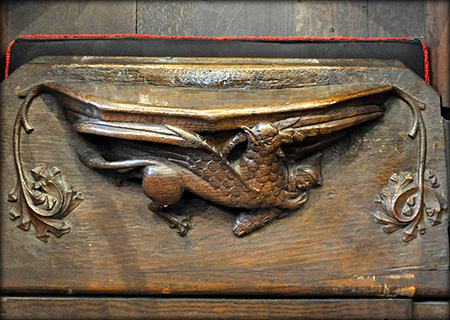
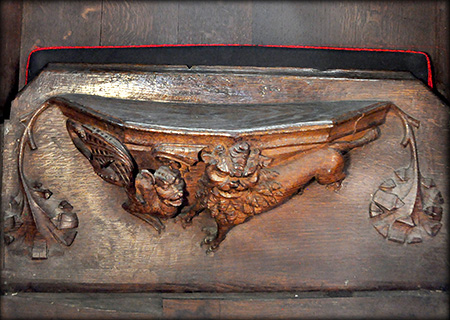
| Pictured below right is the final 15th century misericord it features a carving of a Lion and a Dragon. In medieval times a lion and dragon together would represent the battle between good, represented by the lion, and evil, represented by the dragon. | |
Situated:
SD 73252 36179. Last visit May 2026. Longitude: 2° 24' 28.1" W Latitude: 53° 49' 16.3" N Photos: Jim Dempsey |
South 09 Dragon and Lion Supporters: Leaf foilage |
Ref: The misericords and history of St Mary's, Whalley www.misericords.co.uk, an amazing website featuring misericords worldwide. Whalley www.greatenglishchurches.co.uk Whalley Parish Church, Whalley, near Clitheroe – Lancashire Past www.lancashirepast.com Misericords of Whalley | Salem Chapel, Martin Top www.martintop.org.uk Medieval Bestiary : Animals in the Middle Ages www.bestiary.ca Saint Mary and All Saints Parish Church Guide. |
|



.jpg)
.jpg)
.jpg)